ExploreCareers
Qualitative academic research studying the intersection of career exploration and modern technology, with the goal of better understanding how to best supplement high school students in their career exploration journey.
Client
Tech4Good Lab @ UCSC
Year
2023 - 2025
Project type
UX Research / UI Design
Credits
Lead UX Researcher
Our Goal: Supplementing Youth Career Exploration
Career exploration often proves to be a very challenging time in a young individual's life. While schools do their best to provide students with the necessary resources to make an informed choice, they instead end up overwhelmed and confused by the multitude of conflicting advice and options. This anxiety is further compounded by the pressure of making seemingly life-defining choices at such a young and inexperienced age. We hope that by studying how to best support them in this process, the students can more confidently make informed and prepared career decisions.
Literature Review: Identifying the Gap
In our review of existing academic literature surrounding high school career exploration, we observed a lack of research in modern contexts. Existing literature primarily covered traditional career exploration resources, such as career counselors, libraries, and anecdotal advice from friends and family, but they fail to address modern technology and resources.
Today, high school students can also access career knowledge through a variety of online resources: short-form content like TikTok and Instagram reels, online career databases, and emerging LLM's.
We then established a framework upon which we would base our analysis of students' developmental progress, the Meeus-Crocetti model, which is an identity-development framework built upon the works of psychologists Erik Erikson and James Marcia.
The Qualitative Research
The Tool: The ExploreCareers Platform and CareersBot
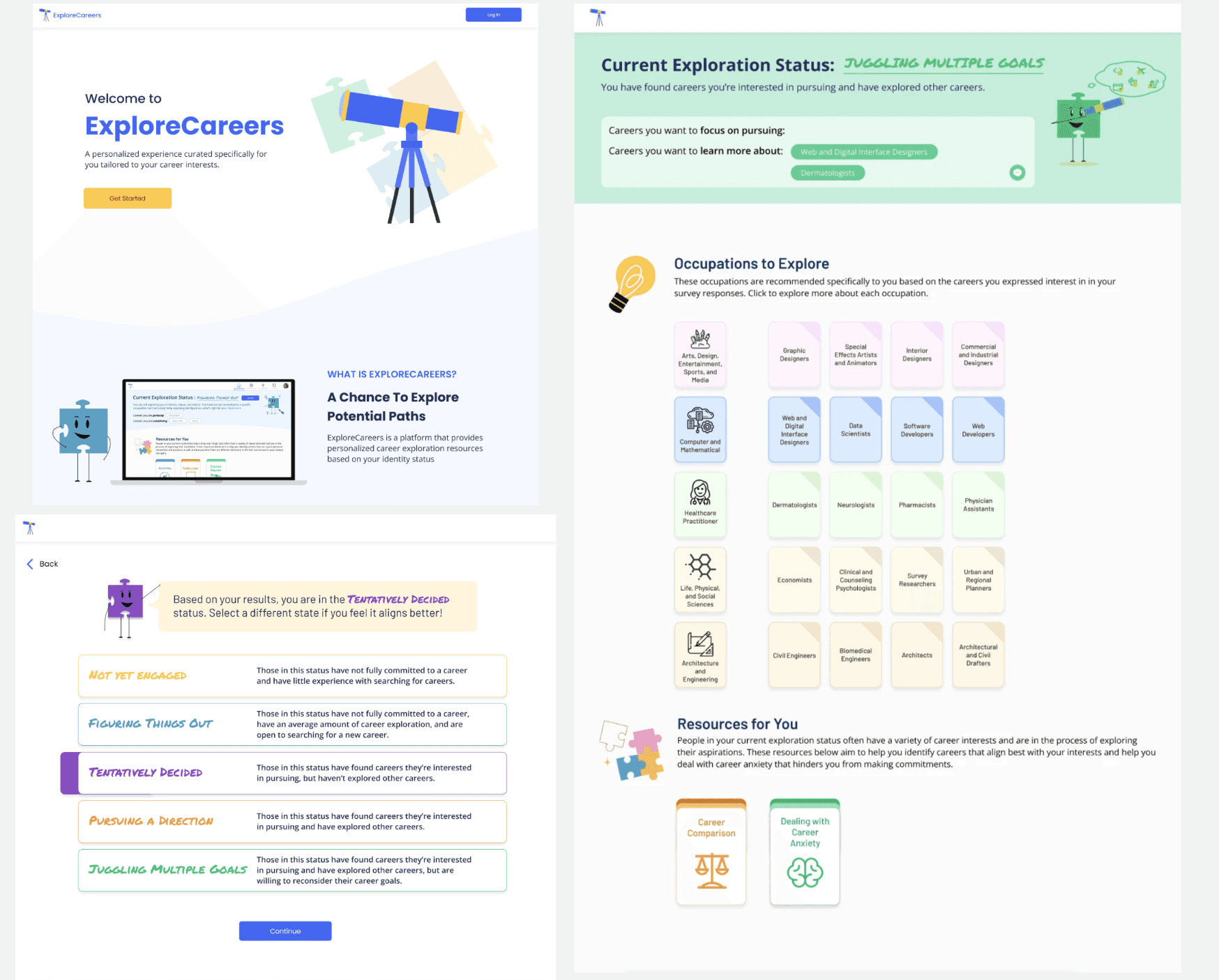
We designed a platform that synthesizes career guidance and occupational data into one place, all personalized towards the student's own interests, experiences, and skills. Students' respective career exploration progress and status were determined by where they fit into the Meeus-Crocetti model, which we then used to tailor the content to their needs.
We included short-form TikTok-style videos (e.g., day-in-the-life content), career database statistics (i.e., O*NET), and a GPT-based CareersBot chatbot into our platform, intending to cover the various online content that younger students today might consume. We also designed a page that aggregated various resources for career anxiety, hoping to address any stress they might have surrounding the career exploration process.

User Interviews
Partnering with local high schools, we conducted two sets (one for ExploreCareers, and the second for the CareersBot) of user interviews and usability testing, with two rounds of interviews each per set. The first interview was structured such that students would talk about their sociocultural and academic backgrounds as well as any work and internship experience they might have. Then, they were given a walkthrough of the prototype, followed by a period of exploration in which we observed and took note of how they interacted with the various aforementioned features of the platform.
A week later in a follow-up interview, students talked with us about what features they preferred and what they found most helpful at their respective career exploration status. They went over what worked best, what didn't work, and any pain points that might've inhibited their processes. This process was done for both the ExploreCareers platform as well as the CareersBot chatbot.
Qualitative Analysis
Taking the transcripts and notes from our interviews, we conducted multiple rounds of qualitative analysis on how students approached the two prototypes. We utilized thematic analysis to identify key behaviors in their needs and usage, particularly in relation to their career exploration status. We then compared our findings with each other for each student and cross-referenced our own perspectives of each student's transcripts and actions. From our research, I then started working with my team to map out how exploration status correlated with what students needed from each feature in the prototypes.
Findings
In our research, I found that students typically looked to O*NET statistics for quick, impactful numbers (i.e., salary ranges, industry growth, required skills/experience) that they could not easily find on their own. On the other hand, TikTok videos offered insider information into the day-to-day lives of working professionals, which added a sense of authenticity and relatability that numbers and text could not provide. Unsurprisingly, the TikTok videos also proved to be the most engaging media for the young high school students.
Students in earlier career exploration stages tended to utilize the CareersBot chatbot as a career counselor, answering questions about career responsibilities, salaries, compare different jobs, and other basic information that students could use to gauge their own interest and suitability for a given occupation. Conversely, students in more advanced exploration statuses used the CareersBot to help plan out academic/career trajectories and to look for potential local internships and opportunities.
Academic Writing
Our findings are being synthesized into an academic research paper for submission to an HCI conference, in which I've written and contributed towards multiple iterations of the Related Works, Methods, Results, and Discussions sections.
Conclusion
I hope that our research will help contribute towards more discussion around high school students' career exploration in modern contexts as well as inform on what tools could be used to supplement these processes. I also hope that our work here helps in improving existing career exploration tools to better accommodate today's students' interests and preferred medias.